Showing posts with label Modernising Medical Microbiology. Show all posts

Tuesday, 7 December 2021

New paper: Antimicrobial resistance determinants are associated with Staphylococcus aureus bacteraemia and adaptation to the healthcare environment

Staphylococcus aureus is a leading cause of infectious disease deaths in all countries, with bloodstream infection leading to sepsis a major concern. This new study, published in November in Microbial Genomics, reports genes and genetic variants in Staph. aureus associated severe disease vs asymptomatic carriage, and healthcare vs community carriage.

Our genome-wide association study of 2000 bacterial genomes showed that antibiotic resistance in Staph. aureus is associated with severe disease and the hospital environment:

  • A mutation conferring trimethoprim resistance (dfrB F99Y) and the presence of a gene conferring methicillin resistance (mecA) were both associated with bloodstream infection vs asymptomatic nose carriage.
  • Separately, we demonstrated that a mutation conferring fluoroquinolone resistance (gyrA L84S) and variation in a gene involved in resistance to multiple antibiotics (prsA) were preferentially associated with healthcare-associated carriage vs community-acquired carriage.

The implication – that antibiotic resistance genes may provide survival advantages which mechanistically contribute to the development of disease – is important in the face of the continued global rise of antibiotic resistance.
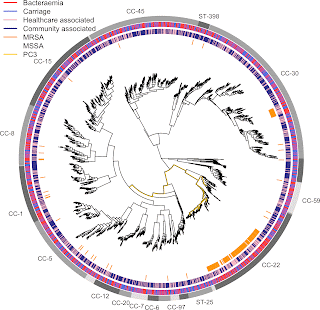

We were also able to shed light on a controversy as to whether different strains of Staph. aureus differ in their propensity to cause severe disease. Interest in this question dates back decades in the literature, and contradictory studies, often based on modest sample sizes, have reached different conclusions. Our comparatively large study, using a whole-genome method that we previously published in Nature Microbiology, found that all strains of Staph. aureus are equally likely to cause severe disease vs asymptomatic carriage.


Monday, 25 February 2019

New paper: PVL toxin associated with pyomyositis


In a new collaborative study published this week in eLife, we report a strong association between Staphylococcus aureus that carry the PVL toxin and pyomyositis, a muscle infection often afflicting children in the tropics.

Catrin Moore and colleagues at the Angkor Children's Hospital in Siem Reap, Cambodia, spent more than a decade collecting S. aureus bacteria from pyomyositis infections in young children, and built a comparable control group of S. aureus carried asymptomatically in children of similar age and location.

When Bernadette Young in our group compared the genomes of cases and controls using statistical tools we developed, she found some strong signals:

  • Most, but not all, pyomyositis was caused by the CC-121 strain, common in Cambodia.
  • The association with CC-121 was driven by the PVL toxin which it carries.
The ability to pinpoint the association to PVL came about because (i) a sub-group of CC-121 that lacked PVL caused no pyomyositis and (ii) pyomyositis-causing S. aureus from backgrounds that rarely caused pyomyositis were unusual in also possessing PVL.

The strength of the PVL-pyomyositis association was extraordinarily strong, so strong that PVL appeared all-but necessary for disease. Moreover, disease appeared to be monogenic, with no other genes involved elsewhere in the bacterial genome. To discover an apparently monogenic disease mechanism for a common disease is very unusual nowadays.

The discovery has immediate practical implications because it draws parallels between pyomyositis and toxin-driven bacterial diseases like tetanus and diphtheria that have proven amenable to immunization. The fact that anti-PVL vaccines have already been developed in other contexts offers hope for the future treatment of this debilitating tropical infection.

Our study throws much-needed light on a subject that has been the subject of heated debate over previous years. Many bacterial toxins, PVL included, have been implicated in diverse S. aureus disease manifestations, often without sound evidence. Because PVL is known to contribute to angry, pus-filled skin infections, and has been observed in bacteria causing rare and severe S. aureus infections, some authors have implicated it in dangerous diseases including necrotizing pneumonia, septic arthritis and pyomyositis, but detailed meta-analyses have dismissed these claims as not substantiated. Our GWAS approach offers unprecedented robustness over previous generations of candidate gene studies by accounting for bacterial genetic variation across the entire genome.

If you are interested, please take a closer look at the paper.

Friday, 18 May 2018

The group has moved to the Big Data Institute, University of Oxford

From April we have moved to the Big Data Institute, Nuffield Department of Population Health at the University of Oxford. The group is maintaining its close links to the Modernising Medical Microbiology Consortium and the John Radcliffe Hospital, Oxford. I am grateful to the Robertson Foundation for funding. We're excited about joining new colleagues and benefiting from their expertise in epidemiology, health informatics, genetics and infection, while continuing to cultivate strong links with our existing collaborators in Oxford and around the world.

Friday, 23 September 2016

Prize PhD Studentships available

I am offering two PhD projects as part of the annual Nuffield Department of Medicine Prize Studentship competition:
These are fully-funded, four-year awards open to outstanding students of any nationality. Applicants nominate three projects, in order of preference, from the available pool. For how to apply, click here. Only applications submitted through the online system will be considered, but interested applicants are welcome to contact me informally. The deadline for applications is noon, 6th January 2017.

In addition to my projects, the Modernising Medical Microbiology project has announced the following PhD projects as part of the competition:

Wednesday, 30 March 2016

CRyPTIC: rapid diagnosis of drug resistance in TB

The Modernising Medical Microbiology consortium has announced a new worldwide collaboration called CRyPTIC to speed up diagnosis of antibiotic resistant tuberculosis (TB).

TB infects nearly 10 million people each year and kills 1.5 million, making it one of the leading causes of death worldwide. Almost half a million people each year develop multidrug-resistant (MDR) TB, which defies common TB treatments. Time consuming tests must be run to identify MDR-TB and which drugs will work or fail. This delays diagnosis and creates uncertainty about the best drugs to prescribe to individual patients.

CRyPTIC aims to hasten the identification of MDR-TB using whole genome sequencing to identify genetic variants that give resistance to particular drugs. The project is funded by a $2.2m grant from the Bill & Melinda Gates Foundation and a £4m grant from the Wellcome Trust and MRC Newton Fund.

CRyPTIC aims to collect and analyse 100,000 TB cases from across the world, providing a database of MDR-TB that will underpin diagnosis using WGS. Samples from across Africa, Asia, Europe and the Americas will be collected by teams at more than a dozen centres They will conduct drug resistance testing and much of the genome sequencing. Read more information here.

Friday, 6 June 2014

Cheltenham Science Festival

Earlier this week members of the group represented the Nuffield Department of Medicine at the Cheltenham Science Festival with our Modernising Medical Microbiology stall, featuring the Antibiotic Resistance Coconut Shy and the Genome Evolution Dance Mat.

Antibiotic Resistance Coconut Shy
Antibiotic Resistance Coconut Shy: The children (and adults) visiting the stall were given five bean bags (antibiotics) to throw at the coconuts (bacterial pathogens) to try to knock them off. The front row of coconuts, representing bacteria more susceptible to antibiotics, were easier to knock off than the back row, which represented more resistant bacteria. The aim was to show the children that an unwanted side effect of using antibiotics is to increase the frequency of resistant bacteria, because they were usually the ones left standing.

The game was more difficult than it looks, and just one visitor knocked off all five coconuts. We gave out NDM pens to the sixty visitors who managed to knock off three or more.

Microscope and Top Trumps
Digital Microscope: We brought along a light microscope to show the children what bacteria really look like, which helps emphasize how small they are since they are difficult to see even under the highest magnification. We prepared slides for several Gram positive and Gram negative species, and provided a key to help identify them. We also brought along a number of games that have been used in previous departmental outreach activities, including Pathogen Top Trumps and Fact or Fiction.

Genome Evolution Dance Mat
Genome Evolution Dance Mat: In this game, the children had to copy a bacterial DNA sequence by replicating a sequence of dance moves (up=A, left=C, right=G, down=T) without introducing new errors (mutations). Any mutations that were introduced were passed on to the next template sequence. In this way we aimed to show how mutations occur by errors in DNA replication, and that they are inherited. This generates unique DNA fingerprints for bacteria, which we can use to track the spread of outbreaks.

Outbreak Map
The game, which was kindly programmed by Gareth Jenkin-Jones, included a form of natural selection, so that if too many errors were introduced at once, the sequence was considered inviable and did not survive to be passed on. There was also a speed control, which was handy since some people appear to have spent a lot more of their youth playing dance mats than others.

Outbreak Map: We made an Outbreak Map to show the reach of our stall over the day, with visitors that scored highly on the coconut shy pushing in pins to show where they had travelled from. Had we been handing out germs instead of pens, we could have started outbreaks as far afield as Edinburgh, France and Spain, as well as a large cluster in Cheltenham and the surrounding counties.

Other research groups are representing the department throughout the week.

NDM Microbiology Stall at the Cheltenham Science Festival (L-R): Sarah Earle, Louise Pankhurst, Danny Wilson, Liz Batty, Dilrini De Silva, Jess Hedge, Catrin Moore. Amy Mason, Gareth Jenkin-Jones and Jane Charlesworth also helped with the preparations, and Jen Bardsley co-ordinated all the NDM Stalls.

Tuesday, 1 October 2013

The role of hospital transmission in Clostridium difficile infection

This week the Modernising Medical Microbiology consortium at Oxford published the findings of a six-year study into the transmission of the hospital "superbug" Clostridium difficile. The research, which appears in the New England Journal of Medicine, shows that the majority of new cases cannot be traced to other infections in hospital, and indicates instead that there must be a large, as yet unidentified, reservoir of C. difficile infectious to humans. This finding is important because it suggests that there is a limit to which more and more intense hospital cleaning - important though it has been - can continue to have in reducing C. difficile infection.

The research, which is the result of a tireless effort by a large number of my colleagues - notably David Eyre, Tim Peto and Sarah Walker - used bacterial whole genome sequencing to detect within-hospital transmission by searching for extremely closely related bacterial strains among more than 1200 cases of C. difficile infection that occurred in Oxfordshire between September 2007 and March 2011. The consortium is currently developing the approach for routine microbiology diagnostics and infection control, with a view to eventual roll-out across the NHS.

Thursday, 15 November 2012

Postdoctoral Positions in Pathogen Genomics

These positions are now closed. There are currently seven posts advertised to join the Pathogen Genomics group at the Nuffield Department of Medicine in Oxford. Prof Derrick Crook and colleagues are seeking exceptional, creative, quantitatively minded scientists to join a multidisciplinary team of researchers using population genomics to understand the evolution and transmission of human pathogens. We are seeking to appoint a number of promising young researchers to extend our existing strengths in the areas of phylogenomics, statistical genetics and bioinformatics.

The group is studying a range of bacterial and viral pathogens including tuberculosis, Staphylococcus aureus, Clostridium difficile, HIV, norovirus and hepatitis C virus. Our research interests include within-host evolution, the genetic basis of virulence, transmission dynamics and outbreak investigation via real-time genomics.

A major translational goal of the project is to exploit the transformative effect of population genomics on bacteriology to improve routine clinical practice in public health and microbiology laboratories.

The research is supported by the UKCRC Modernising Medical Microbiology Consortium, the Health Innovation Challenge Fund, the NHS National Institute for Health Research, the Oxford Biomedical Research Centre, Institut Merieux and the Oxford Martin School, and pursued in collaboration with clinical colleagues in Leeds, Birmingham and Brighton, the Health Protection Agency and the WTSI.
The deadline for applications varies by position, between 26-28 November 2012.
For examples of recent papers see:
http://www.thelancet.com/journals/laninf/article/PIIS1473-3099%2812%2970277-3/fulltext
http://www.pnas.org/content/109/12/4550.full
http://bmjopen.bmj.com/content/2/3/e001124.full.pdf+html
http://www.nature.com/nrg/journal/v13/n9/pdf/nrg3226.pdf
http://www.plospathogens.org/article/info%3Adoi%2F10.1371%2Fjournal.ppat.1002874

For more information visit:
http://www.modmedmicro.ac.uk
http://www.oxfordmartin.ox.ac.uk/projects/view/127

Monday, 5 November 2012

James Martin Fellowship

This position is now closed. A prestigious James Martin Fellowship funded by the Oxford Martin School is available in my research group for a highly motivated and creative population geneticist interested in developing cutting edge methods for the analysis of high-throughput whole genome sequencing data to better understand the evolution and epidemiology of the major pathogens HIV and Hepatitis C Virus.

The position, which is part of the Curing Chronic Viral Infections project, is fully funded for three years and is affiliated with the Institute for Emerging Infections, the Modernising Medical Microbiology consortium, the Peter Medawar Building for Pathogen Research and the Nuffield Department of Medicine. The ideal candidate will have a track record in statistical or computational genetics and experience of programming in a language such as C++ or Java.

Full details can be found on the University of Oxford Recruitment website. Please send informal enquiries, with a CV, to me by email. The deadline for applications is 12 noon on 27th November 2012.

Monday, 5 March 2012

PNAS paper on staphylococcal evolution during infection

Today in PNAS Early Edition my colleagues and I have a paper published reporting the genome evolution of Staphylococcus aureus during the transition from prolonged nasal carriage to invasive disease. Since Staph. aureus, a major bacterial cause of life-threatening infections, is carried without symptoms by a quarter of healthy adults, a natural question is to ask what genetic changes - if any - accompany the transition to invasive disease. The opportunity to pursue this question arose from a detailed epidemiological investigation of asymptomatic Staph. aureus nasal carriage set up by colleagues of mine including Derrick Crook and Kyle Knox. The study has recruited over 1,000 participants in Oxfordshire since it began running in October 2008. One participant developed a bloodstream infection that was indistinguishable from the strain of Staph. aureus persistently carried in the nose for the previous 13 months. Members of the Modernising Medical Microbiology consortium, led by Derrick and Rory Bowden, sequenced the genomes of 68 bacterial colonies isolated from the nasal and blood samples from this participant, and 101 colonies from nasal samples from two other participants that did not go on to develop disease. Bernadette Young and Tanya Golubchik analyzed the genome evolution of these bacterial populations, discovering an unusual pattern in the mutations that occurred between nasal carriage and invasive disease: mutations that led to prematurely truncated proteins were significantly over-represented, including one in a gene previously associated with virulence in bacteria. To know more, read the full open access article.

Saturday, 1 January 2011

Group Member Profiles Updated

Richard Everitt and Bethany Dearlove, postdoctoral scientist and D.Phil. student in my lab have posted their profiles and research interests to my website. Both joined in October, Richard from the University of Bristol where he was Brunel Fellow in Statistics and Bethany from the University of Reading where she read a masters in Biometry.

Richard is investigating patterns of genetic diversity and linkage disequilibrium in Staphylococcus aureus, while Bethany is studying the transmission dynamics of norovirus using population genetics and epidemiological modelling. Both are funded jointly by the UKCRC project Modernising Medical Microbiology and the Nuffield Department of Clinical Medicine. For more information, see their individual profiles.

Saturday, 18 September 2010

Evolutionary Genetics for Translational Research

This month saw the 2010 Infectious Disease Genomics & Global Health meeting at Hinxton, which attracted a good number of people involved in the Modernising Medical Microbiology consortium, of which I am a participant. Rory Bowden and Rosalind Harding presented our group's progress on piecing together intra-host evolution of Staphylococcus aureus and reconstructing transmission chains in Clostridium difficile. My role in the projects has so far been one of assisting in ongoing evolutionary analyses and collaborating in the design of bioinformatics pipelines to make sense of the raw Illumina short-read sequencing data. At the same time I have been devising research plans for my own group, and spending time in the lab preparing sequencing experiments with Bernadette Young. In the poster I presented at Hinxton (available here), and at an internal talk I gave earlier in the year (slides here) I set out what I see as the strengths of Evolutionary Genetics for addressing translational medical problems including
  • Tracking the transmission of hospital-acquired pathogens
  • Understanding transmission dynamics at the population level
  • Identifying the mechanistic and adaptive basis of disease
  • Explaining how pathogens emerge, persist and spread globally
Of the many stimulating talks at the Hinxton conference, those by Dominic Kwiatkowski on the population genomics of Plasmodium falciparum, Christophe Fraser on "hyper-recombination" in Streptococcus pneumoniae and Paul Keim on the challenges for understanding the population genetics of non-clonal bacterial pathogens particularly interested me. Prof Keim gave an equally captivating talk the following day at the Health Protection 2010 meeting in Warwick on his microbial forensics work tracing the origin of Bacillus anthracis spores used in bioterrorism attacks. What I especially admired about his presentations was the dogged pursuit of new methods and ways of thinking in order to better address the biological questions at hand.

Saturday, 27 February 2010

Postdoc and PhD position available

These positions are now closed.

Advertised today in Nature and on Thursday in New Scientist are two positions in my lab. I am looking for a postdoc and a PhD student to work on the genome evolution and epidemiology of four human pathogens as part of the Modernising Medical Microbiology project. Three of the pathogens share the theme of hospital-acquired infections: they are Staphylococcus aureus (of MRSA infamy), Clostridium difficile and norovirus (aka winter vomiting disease). The fourth is Mycobacterium tuberculosis (TB) which is a re-emerging problem in developed countries.

The aim of the project is to use whole genome sequencing of many isolates (100s to 1000s) in order to reconstruct evolutionary relationships and deconstruct transmission routes. We hope to develop the technology to the stage that we can trace the spread of pathogens in real time, and uncover the epidemiological triggers for the spread of disease.

As of January I have relocated to the Nuffield Department of Clinical Medicine at the University of Oxford, and the project is a collaborative affair between people at Oxford (including Rory Bowden, Derrick Crook, Peter Donnelly and Rosalind Harding), the Wellcome Trust Sanger Institute, the NHS and the Health Protection Agency. The project is funded by the UKCRC and further details of the positions are available online for the postdoc and PhD studentship. The closing date for applications is Friday, 2 April 2010.