This year the Royal Society's Summer Science Exhibition was online, and included highlights and updates from previous exhibitors, among them ours from 2018. This video was posted on Tuesday's session:
Showing posts with label Public Engagement. Show all posts
Showing posts with label Public Engagement. Show all posts
Monday, 20 July 2020
Wednesday, 27 June 2018
Royal Society Summer Science Exhibition Stall July 2-8
Next week researchers from the Modernising Medical Microbiology consortium, collaborating groups and I will exhibit the Resistance is Futile stall at the Royal Society Summer Science Exhibition. The exhibition is a free event in central London open to all visitors. Our stall is an opportunity to tell visitors about our research, and how advances in genetics are influencing day-to-day life. On show at the Resistance is Futile stall:


Oxford Nanopore Technology Demos
 Antibiotic use gives resistance mutants a strong advantage so they rapidly increase in frequency.
The exhibition runs from Monday 2 July - Sunday 8 July at Carlton House Terrace, London, SW1Y 5AG. For more information about our stall click here and for general visitor information about the exhibition click here. Please spread the word!
During the exhibition we will be tweeting from @ResistanceIF
Our stall is generously supported by Oxford Nanopore Technology, the Nuffield Department of Medicine, and through public engagement research funding awarded to our research groups by the Wellcome Trust, the Royal Society, the National Institute for Health Research, the Oxford Biomedical Research Centre, the Natural Environment Research Council, the Medical Research Council, the Newton Fund and the Bill & Melinda Gates Foundation.
Tuesday, 21 July 2015
Resistance is Futile: Science Museum Lates and Cheltenham Science Festival
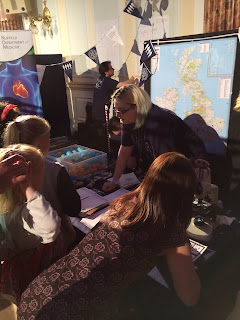
Some photos from this summer's Science Museum Lates event with the Royal Society and the Cheltenham Science Festival. Thanks to everyone who helped: Liz Batty, Phelim Bradley, Jane Charlesworth, Dilly De Silva, Sarah Earle, Nicki Fawcett, Jess Hedge, Brian Mackenwells, Amy Mason, Charvy Narain, Anna Sheppard and Jessie Wu!
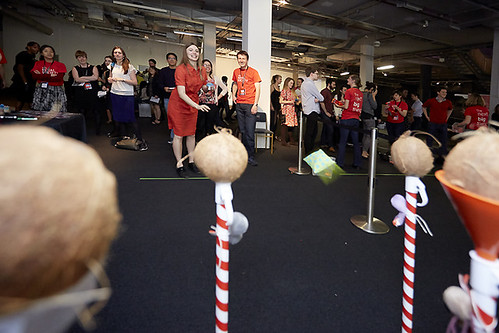

We had two activities. Dance Dance Evolution is a computer game which uses an adapted dance-dance mat with four squares representing bases in the DNA (A, C, G and T). Participants act as the DNA replicator, and mistakes cause mutations in the DNA sequence. The next dancer copies the sequence left by the previous dancer, demonstrating evolution by mutation over time. The game shows the percentage similarity of the current sequence to the original sequence, showing the amount of 'evolution' over the time period of the game. We discussed with visitors the relevance of this to the development of antibiotic resistance.

We had two activities. Dance Dance Evolution is a computer game which uses an adapted dance-dance mat with four squares representing bases in the DNA (A, C, G and T). Participants act as the DNA replicator, and mistakes cause mutations in the DNA sequence. The next dancer copies the sequence left by the previous dancer, demonstrating evolution by mutation over time. The game shows the percentage similarity of the current sequence to the original sequence, showing the amount of 'evolution' over the time period of the game. We discussed with visitors the relevance of this to the development of antibiotic resistance.
Friday, 6 June 2014
Cheltenham Science Festival
 |
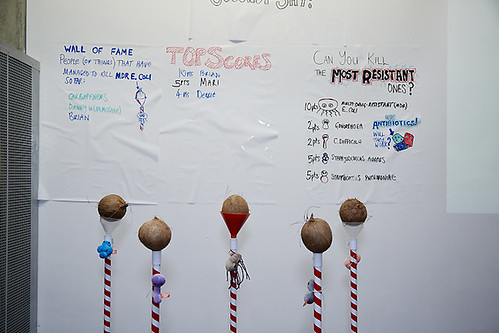
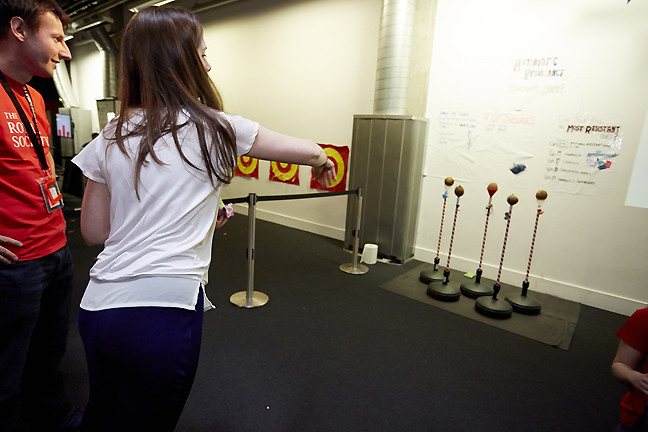
| Antibiotic Resistance Coconut Shy |
The game was more difficult than it looks, and just one visitor knocked off all five coconuts. We gave out NDM pens to the sixty visitors who managed to knock off three or more.
 |
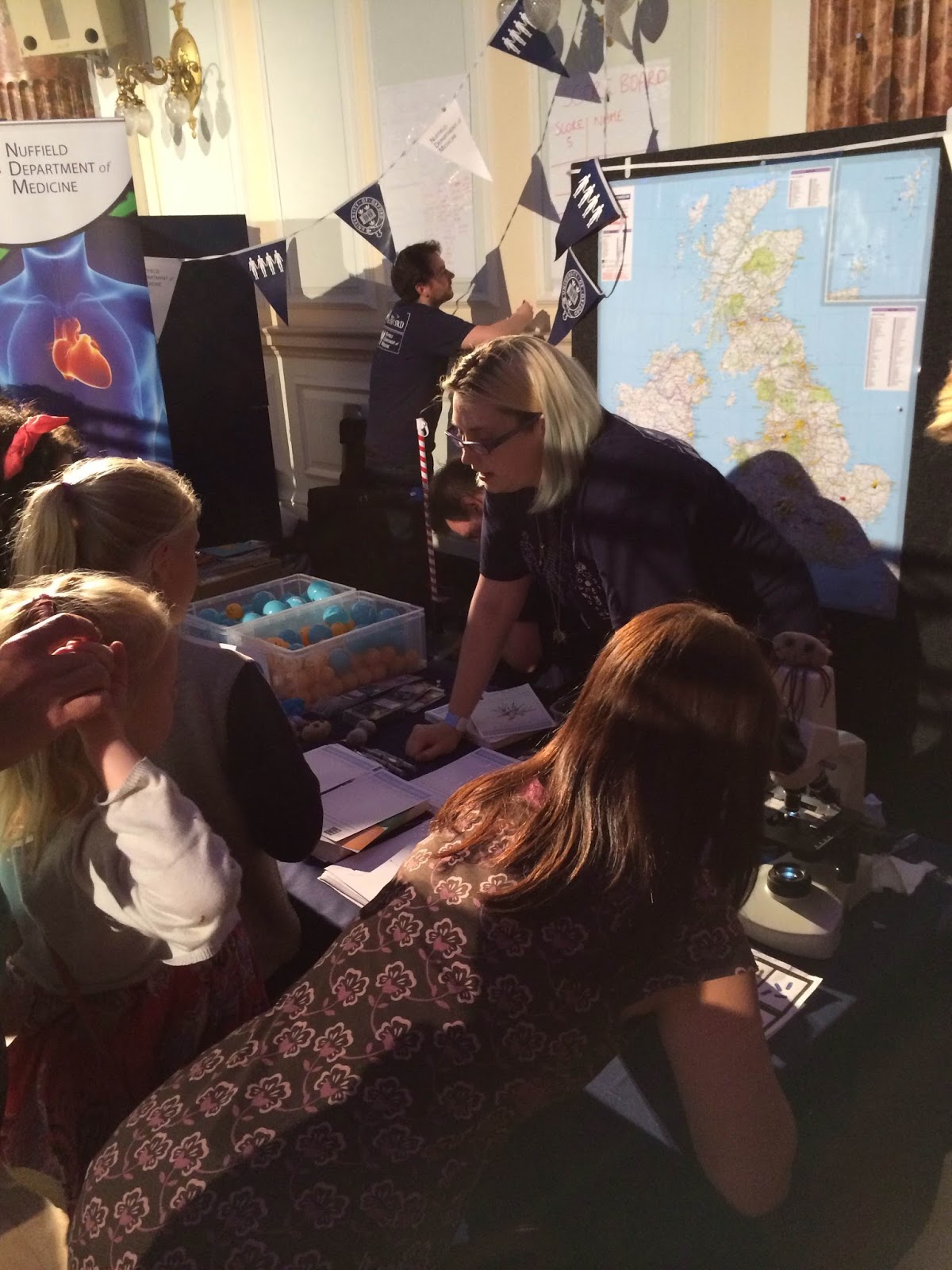
| Microscope and Top Trumps |
 |
| Genome Evolution Dance Mat |
 |
| Outbreak Map |
Outbreak Map: We made an Outbreak Map to show the reach of our stall over the day, with visitors that scored highly on the coconut shy pushing in pins to show where they had travelled from. Had we been handing out germs instead of pens, we could have started outbreaks as far afield as Edinburgh, France and Spain, as well as a large cluster in Cheltenham and the surrounding counties.
Other research groups are representing the department throughout the week.
 |
| NDM Microbiology Stall at the Cheltenham Science Festival (L-R): Sarah Earle, Louise Pankhurst, Danny Wilson, Liz Batty, Dilrini De Silva, Jess Hedge, Catrin Moore. Amy Mason, Gareth Jenkin-Jones and Jane Charlesworth also helped with the preparations, and Jen Bardsley co-ordinated all the NDM Stalls. |
Subscribe to:
Posts (Atom)


 Posts