The closing date for applications for this post is noon on Wednesday 15th April 2020.
We are seeking an exceptional researcher with a track record in methods development for Statistical Genomics and an interest in Infectious Disease to join our group at the Big Data Institute. Our research focuses on Bacterial Genomics, Genome-Wide Association Studies and Population Genetics. The aim of the post is to conduct innovative research within the group's range of interests and to make use of the opportunities afforded by our outstanding collaborators. We welcome candidates who wish to use the opportunity as a stepping stone to independent funding.
The Oxford University Big Data Institute (BDI) is an interdisciplinary research centre aiming to develop, evaluate and deploy efficient methods for acquiring and analysing biomedical data at scale and for exploiting the opportunities arising from such studies. The Nuffield Department of Population Health, a partner in the BDI, contains world-renowned population health research groups and is an excellent environment for multi-disciplinary teaching and research.
The Postdoctoral Researcher in Statistical Genomics will join our team which has expertise in microbiology, genomics, evolution, population genetics and statistical inference. Responsibilities include planning a research project and milestones with help and guidance from the group, preparing manuscripts for publication, keeping records of results and methods and tracking milestones, and disseminating results.
To be considered, you need to hold, or be close to completion of, a PhD/DPhil involving statistical methods development. You also need experience of large-scale statistical data analysis, evidence of originating and executing your own academic research ideas and excellent interpersonal skills and the ability to work closely with others in a team.
For informal enquiries, please contact me.
Further details, including how to apply are here: https://my.corehr.com/pls/uoxrecruit/erq_jobspec_details_form.jobspec?p_id=145506
Showing posts with label Bacteria. Show all posts
Showing posts with label Bacteria. Show all posts
Monday, 16 March 2020
Wednesday, 18 July 2018
Bacterial Doubling Times in the Wild
How fast do bacteria grow outside the laboratory? This simple question is very difficult to address directly, because it is near-impossible to track a lineage of bacterial cells, ancestor-to-decendant, inside an infected patient or through a river. Now in new work published in Proceedings B, Beth Gibson, Ed Feil, Adam Eyre-Walker and I exploit genome sequencing to try to get a handle on the problem indirectly.
We have done it by comparing two known quantities and taking the ratio: the rate at which DNA mutates in bacteria per year, and the rate it mutates per replication. This tells us in theory how many replications there are per year.
The mutation rate per replication has long been studied in the laboratory, and is around once per billion letters. Meanwhile, the recent avalanche of genomic data has allowed microbiologists to quantify the rate at which bacteria evolve over short time scales such as a year, including during outbreaks and even within individual infected patients. Most bugs mutate about once per million letters per year, with ten-fold variation above and below this not uncommon among different species.
For five species both these quantities exist. The fastest bug we looked at causes cholera and we estimate it doubles once every hour on average (give or take 30 minutes). The slowest was Salmonella, which we estimate doubles once a day on average (give or take 8 hours). In between were Staph. aureus and Pseudomonas at about two hours each, and E. coli at 15 hours. These are average over the very diverse and often hostile conditions that a bacterial cell may find itself in during the course of its natural lifecycle. To find out more about the work, please check out the paper.
We have done it by comparing two known quantities and taking the ratio: the rate at which DNA mutates in bacteria per year, and the rate it mutates per replication. This tells us in theory how many replications there are per year.
The mutation rate per replication has long been studied in the laboratory, and is around once per billion letters. Meanwhile, the recent avalanche of genomic data has allowed microbiologists to quantify the rate at which bacteria evolve over short time scales such as a year, including during outbreaks and even within individual infected patients. Most bugs mutate about once per million letters per year, with ten-fold variation above and below this not uncommon among different species.
For five species both these quantities exist. The fastest bug we looked at causes cholera and we estimate it doubles once every hour on average (give or take 30 minutes). The slowest was Salmonella, which we estimate doubles once a day on average (give or take 8 hours). In between were Staph. aureus and Pseudomonas at about two hours each, and E. coli at 15 hours. These are average over the very diverse and often hostile conditions that a bacterial cell may find itself in during the course of its natural lifecycle. To find out more about the work, please check out the paper.
Thursday, 7 April 2016
Making the most of bacterial GWAS: new paper in Nature Microbiology
In a new paper published this week in Nature Microbiology, we report the performance of genome wide association studies (GWAS) in bacteria to identify causal mechanisms of antibiotic resistance in four major pathogens, and introduce a new method, bugwas, to make the most of bacterial GWAS for traits under less strong selection.
As explained by Sarah Earle, joint first author with Jessie Wu and Jane Charlesworth, the problem with GWAS in bacteria is strong population structure and the consequent strong coinheritance of genetic variants throughout the genome. This phenomenon - known as genome-wide linkage disequilibrium (LD) - comes about because exchange of genes is relatively infrequent in bacteria, which reproduce clonally, compared to organisms that exchange genes every generation through sexual reproduction.
Genome-wide LD makes it difficult for GWAS to distinguish variants that causally influence a trait from other, coinherited variants that have no direct effect on the trait.
In the case of antibiotic resistance - a trait of high importance to human health - bacteria are under extraordinary selection pressures because resistance is a matter of life and death, to them as well as their human host. This helps overcome coinheritance and pinpoint causal variants because antibiotic usage selects for the independent evolution of the same resistance-causing variants in different genetic backgrounds.
Consequently, bacterial GWAS works very efficiently for antibiotic resistance: the variants most significantly associated with antibiotic resistance in 26 out of the 27 GWAS we performed were genuine resistance-conferring mutations. In the 27th we uncovered a putative novel mechanism of resistance to cefazolin in E. coli. These results for 17 antibiotics (ampicillin, cefazolin, cefuroxime, ceftriaxone, ciprofloxacin, erythromycin, ethambutol, fusidic acid, gentamicin, isoniazid, penicillin, pyrazinamide, methicillin, rifampicin, tetracycline, tobramycin and trimethoprim) across four species (E. coli, K. pneumoniae, M. tuberculosis and S. aureus) build on earlier work investigating beta-lactam resistance in S. pneumoniae, and convincingly demonstrate the potential for bacterial GWAS to discover new genes underlying important traits under strong selection.
What about traits under less strong selection, which probably includes pretty much every other bacterial trait? We show in this context that coinheritance poses a major challenge, based on detailed simulations. Often it may not be possible to use GWAS to pinpoint individual variants responsible for different traits because they are coinherited with - possibly many - other uninvolved variants.
But all is not lost. We show that even when individual locus-level effects cannot be pinpointed, there is often excellent power to characterize lineage-level differences in phenotype between strains. This is helpful for multiple reasons: (1) we often conceptualize trait variability in bacteria at the level of strain-to-strain differences (2) these differences can be highly predictive (3) we can prioritize variants for functional follow-up based on their contribution to strain-level differences.
These concepts represent a substantial departure from regular GWAS. In the human setting for instance, lineage-level differences are usually discarded as uninteresting or artefactual, and variants are almost always prioritized based on statistical evidence for involvement over-and-above any contribution to lineage-level differences. In the bacterial setting, we are forced to depart from these conventions because a large proportion of all genetic variation is strongly strain-stratified. To find out more, see the paper and try our methods.
As explained by Sarah Earle, joint first author with Jessie Wu and Jane Charlesworth, the problem with GWAS in bacteria is strong population structure and the consequent strong coinheritance of genetic variants throughout the genome. This phenomenon - known as genome-wide linkage disequilibrium (LD) - comes about because exchange of genes is relatively infrequent in bacteria, which reproduce clonally, compared to organisms that exchange genes every generation through sexual reproduction.
Genome-wide LD makes it difficult for GWAS to distinguish variants that causally influence a trait from other, coinherited variants that have no direct effect on the trait.
In the case of antibiotic resistance - a trait of high importance to human health - bacteria are under extraordinary selection pressures because resistance is a matter of life and death, to them as well as their human host. This helps overcome coinheritance and pinpoint causal variants because antibiotic usage selects for the independent evolution of the same resistance-causing variants in different genetic backgrounds.
Consequently, bacterial GWAS works very efficiently for antibiotic resistance: the variants most significantly associated with antibiotic resistance in 26 out of the 27 GWAS we performed were genuine resistance-conferring mutations. In the 27th we uncovered a putative novel mechanism of resistance to cefazolin in E. coli. These results for 17 antibiotics (ampicillin, cefazolin, cefuroxime, ceftriaxone, ciprofloxacin, erythromycin, ethambutol, fusidic acid, gentamicin, isoniazid, penicillin, pyrazinamide, methicillin, rifampicin, tetracycline, tobramycin and trimethoprim) across four species (E. coli, K. pneumoniae, M. tuberculosis and S. aureus) build on earlier work investigating beta-lactam resistance in S. pneumoniae, and convincingly demonstrate the potential for bacterial GWAS to discover new genes underlying important traits under strong selection.
What about traits under less strong selection, which probably includes pretty much every other bacterial trait? We show in this context that coinheritance poses a major challenge, based on detailed simulations. Often it may not be possible to use GWAS to pinpoint individual variants responsible for different traits because they are coinherited with - possibly many - other uninvolved variants.
But all is not lost. We show that even when individual locus-level effects cannot be pinpointed, there is often excellent power to characterize lineage-level differences in phenotype between strains. This is helpful for multiple reasons: (1) we often conceptualize trait variability in bacteria at the level of strain-to-strain differences (2) these differences can be highly predictive (3) we can prioritize variants for functional follow-up based on their contribution to strain-level differences.
These concepts represent a substantial departure from regular GWAS. In the human setting for instance, lineage-level differences are usually discarded as uninteresting or artefactual, and variants are almost always prioritized based on statistical evidence for involvement over-and-above any contribution to lineage-level differences. In the bacterial setting, we are forced to depart from these conventions because a large proportion of all genetic variation is strongly strain-stratified. To find out more, see the paper and try our methods.
Wednesday, 20 January 2016
Nature Reviews Microbiology: Within-host evolution of bacterial pathogens
 Our new review of what genomics has taught us about Within-host evolution of bacterial pathogens has been published in Nature Reviews Microbiology.
Friday, 24 July 2015
New Journal: Microbial Genomics

"Microbial Genomics (MGen) publishes high quality, original research on archaea, bacteria, microbial eukaryotes and viruses. MGen welcomes papers that use genomic approaches to understand microbial evolution, population genomics and phylogeography, outbreaks and epidemiological investigations, impact of climate or changing niche, metagenomic and whole transcriptome studies, and bioinformatic analysis covering the breadth of microbiology, from clinically important pathogens to microbial life in diverse ecosystems."
The journal, whose tag line is Bases to Biology, will publish microbiological discoveries and innovations in research methods and bioinformatics. The journal is headed by renowned Wellcome Trust Sanger Institute scientists Stephen Bentley and Nicholas Thompson with an impressive editorial board that I joined earlier this year. Article processing charges have been waived during the journal's launch year - so get in there fast!
Tuesday, 31 March 2015
ClonalFrameML: accounting for recombination in bacterial phylogenies
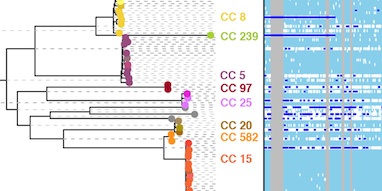
Two forms of phylogenetic distortion are caused by recombination. The first affects the shape of the tree topology. Although this is a potentially serious difficulty, Jessica Hedge and I recently showed that phylogenies estimated from whole bacterial genomes are surprisingly robust to this problem. The second affects the lengths of the branches. When genetic material is replaced by a homologous but distantly related sequence, it gives the appearance of a cluster of substitutions in the genome, and this can exaggerate branch lengths. ClonalFrameML detects these clusters of substitutions, identifies them as recombination events, and corrects the branch lengths of the tree.
Correcting for recombination is important in a variety of settings. In transmission studies, recent transmission between patients can be detected by comparing the genomes of the infecting bacteria. As we show in the paper, ClonalFrameML improves detection of transmission events by accounting for the tendency of recombination to elevate the evolutionary distance between genomes. We also report the discovery of a remarkably large chromosomal replacement event spanning 310 kilobases that may have led to the evolution of the ST582 strain of Staphylococcus aureus, underlining the importance of recombination over short and long timescales.
ClonalFrameML is a much faster implementation of the popular ClonalFrame method by Xavier and Daniel Falush. It is based on the same underlying assumptions and the same explicit evolutionary model, so it provides interpretable estimates of rates of recombination, the length of DNA imported by recombination, and the relative impact of recombination versus mutation. However, it can now analyse thousands of whole bacterial genomes in a matter of hours, representing a substantial improvement over the earlier method.
Friday, 28 November 2014
New paper: bacterial phylogenetic inference is robust to recombination but demographic inference is not
Published this week in mBio, Jessica Hedge's new paper "Bacterial phylogenetic inference is robust to recombination but demographic inference is not" looks at a long-standing problem: why are phylogenetic trees so popular in bacterial genomics when everyone knows recombination (which is detectable in most species studied) leads to seriously misleading inference? A burst of research activity in the early 2000s showed that homologous recombination - which can result from various forms of horizontal gene transfer in bacteria - can distort phylogenetic trees and lead to false inference of positive selection and demographic growth in methods that rely on them.
In the intervening years there has been intense research in the field of population genetics into approaches that account for recombination, although the practically useful methods rely on approximations because of the inherent difficulties of learning about complex reticulated evolutionary networks that recombination generates. This has led many of my population genetics colleagues to regard - at least privately - the use of phylogenetic trees in recombining species as "bust", and the conclusions drawn from such studies as questionable. In this paper we show that this view is too simple.

In the intervening years there has been intense research in the field of population genetics into approaches that account for recombination, although the practically useful methods rely on approximations because of the inherent difficulties of learning about complex reticulated evolutionary networks that recombination generates. This has led many of my population genetics colleagues to regard - at least privately - the use of phylogenetic trees in recombining species as "bust", and the conclusions drawn from such studies as questionable. In this paper we show that this view is too simple.
Friday, 6 June 2014
Cheltenham Science Festival
 |
| Antibiotic Resistance Coconut Shy |
The game was more difficult than it looks, and just one visitor knocked off all five coconuts. We gave out NDM pens to the sixty visitors who managed to knock off three or more.
 |
| Microscope and Top Trumps |
 |
| Genome Evolution Dance Mat |
 |
| Outbreak Map |
Outbreak Map: We made an Outbreak Map to show the reach of our stall over the day, with visitors that scored highly on the coconut shy pushing in pins to show where they had travelled from. Had we been handing out germs instead of pens, we could have started outbreaks as far afield as Edinburgh, France and Spain, as well as a large cluster in Cheltenham and the surrounding counties.
Other research groups are representing the department throughout the week.
 |
| NDM Microbiology Stall at the Cheltenham Science Festival (L-R): Sarah Earle, Louise Pankhurst, Danny Wilson, Liz Batty, Dilrini De Silva, Jess Hedge, Catrin Moore. Amy Mason, Gareth Jenkin-Jones and Jane Charlesworth also helped with the preparations, and Jen Bardsley co-ordinated all the NDM Stalls. |
Tuesday, 17 September 2013
Sir Henry Dale Fellowship

The project addresses the question of how to detect genes or mutations in bacteria responsible for variability in important traits such as the tendency to cause human disease. Focusing on the hospital-associated pathogens Staphylococcus aureus and Clostridium difficile, the project has the potential to help identify genetic variants that explain why some bacteria cause more severe infections, knowledge that could help develop new drugs and tests that improve patient treatment.
The fellowship runs for five years, and includes support for a postdoctoral research assistant and laboratory costs. I will be advertising a position shortly. If you are interested, please get in touch.
I want to thank the funders and reviewers for supporting this project, and my colleagues who helped me write and re-write the research proposal.
Wednesday, 22 May 2013
Within-host evolution of Staphylococcus aureus during asymptomatic carriage
 Given its notoriety as one of the world's major causes of infection-related deaths, it may come as a surprise that one in three healthy adults carry the human pathogen Staphylococcus aureus in their noses without adverse effects. Indeed, most people carry the bacteria at some point in their lives. So carriage must be seen as the normal state of affairs in the human-S. aureus interaction, and by understanding this state better we can improve our understanding of why, in some people, the bacteria go on to cause life-threatening invasive disease.
This month sees publication of an investigation by my colleagues and me into the evolution of S. aureus during this normal healthy carriage state. The carriers in our study harboured populations of the bacteria that were very closely related but typically not identical, implying that the bacteria had evolved within the human body. The nose appears to be a microcosm of evolution for S. aureus, showing all the different types of genetic variation known at the species level within the noses of these individual carriers. For the most part, within-host evolution of the bacteria was very conservative, but certain proteins expressed on the surface of the bacteria and toxins secreted by the bacteria showed evidence of involvement in a host-pathogen arms race.
The paper, whose lead authors include Tanya Golubchik, Liz Batty, Derrick Crook and Rory Bowden, has received coverage on the EveryONE blog and F1000. I liked Gerald Pier's conclusion, made on the post-publication peer review website: "Given that about 30% of the world's seven billion-plus humans, and an unknown number of animals, are chronically colonized with S. aureus, the tremendous opportunity provided to this organism for generating genetic variation to counteract human efforts to prevent S. aureus infections may be one of the most formidable barriers to overcome in order to develop vaccines and highly effective interventions to lessen the impact of this organism on human and animal health."
Friday, 7 September 2012

Friday, 20 July 2012
Post-doc Positions in Pathogen Genomics
Post-doc positions in Pathogen Genomics are available in my group and Derrick Crook's lab. We will be hiring people to work on pathogen whole genome sequence analysis and bioinformatics. More details available soon. In the meantime, find out about our research:
If you are interested, please get in touch.
If you are interested, please get in touch.
Wednesday, 11 January 2012
SMBE 2012: Microbial Genome Evolution Symposium

High-throughput sequencing makes it possible for the first time to sequence hundreds of microbial genomes rapidly at low cost. These methods have huge potential to significantly improve our understanding of microbial evolution, so that many research projects have recently been set up to generate and analyze such data. This symposium will provide an overview of the progress made by such projects, as well as the many challenges they pose. It is now possible to identify the vast majority of SNPs within large population samples of microbial isolates. These datasets are illuminating the molecular, ecological and population-level dynamic processes occurring over short time scales in natural populations inhabiting a range of habitats from the clinic to the environment. We aim to explore these recent advances and the development of new methods of analyses required to fully exploit these extremely large sequence datasets. Relevant topics include quantifying the variation in the rates of recombination and mutation between closely related lineages, the evolution of base composition, the relative power of drift and selection, examining the acquisition of adaptive traits (e.g. antibiotic resistance, host adaptation, metabolic flexibility, regulatory changes) within a phylogenetic framework, and the distribution of variation over time and space (phylogeography). The role of phage and conjugative elements in structuring populations as both vehicles for gene flow and parasitic elements will also be considered. The symposium will focus on variation within natural populations rather than experimental evolution.
Monday, 16 November 2009
Campylobacter source attribution in New Zealand
 What is the source of the common food poisoning pathogen Campylobacter jejuni was the subject of a paper published in September last year in PLoS Genetics by my colleagues and I, in which we traced the origin of bacterial isolates collected from patients in Lancashire, England. In that study, and a subsequent investigation into campylobacteriosis across Scotland, we found that the majority of cases could be attributed to populations of C. jejuni typically found in poultry.
Now Petra Mullner, Nigel French and colleagues have genetically characterized the C. jejuni populations found in human patients, cattle, sheep, poultry and environmental samples from New Zealand covering the period March 2005 - February 2008. What is special about their study is that the New Zealand poultry industry is a closed system, with no foreign imports, making it possible to directly sample the putative source populations and disease-causing isolates concurrently.

Like the studies in England and Scotland, poultry was the inferred source of the majority of disease in New Zealand. Uniquely however, it was possible to attribute cases separately to the three major poultry suppliers on the islands. One supplier in particular was attributed a disproportionate number of cases using 3 assignment methods, including my method (iSource, soon to be available on this website). Supported in part by this evidence, the New Zealand Food Safety Authority introduced mandatory targets for limiting Campylobacter contamination of poultry products in 2007. Remarkably, the number of cases fell from 15,873 in 2006 before the control measures were introduced to 6,689 in 2008. The next chapter of this intriguing story will be a follow-up study to establish whether the fall in the number of cases corresponded to a reduction in the proportion of campylobacteriosis attributable to poultry sources.
Thursday, 30 October 2008
Inferring niche membership from genetic diversity
 Each Wednesday the Ecology and Evolution department run a journal club called Noon Illumination, and this week I volunteered to lead discussion on a recent article titled Resource Partitioning and Sympatric Differentiation Among Closely Related Bacterioplankton (Science 320: 1081-5), by Dana Hunt and colleagues based at MIT and Ghent. I originally prepared the presentation for a Bacterial Metagenomics workshop in Berlin this July, organized by Daniel Falush.
Of central interest in the paper is a novel methodology that infers habitat/niche based on ecological variables and DNA sequencing in the family of marine bacteria Vibrionaceae. That places it in the wider context of methods that attempt to predict phenotype (in this case niche) from genotype. Their approach is an elegant extension of familiar phylogenetic methods to model habitat switching over evolutionary time. Based on arguments put forward by Christophe Fraser and colleagues, the paper reasons that the ancestral habitat switches they detect are likely to be adaptive because the rate of recombination eclipses the mutation rate sufficiently to preclude the possibility of neutral genetic clustering.
However the high rate of recombination raises some difficulties of interpretation. The principal phylogenetic reconstruction was based on the hsp60 gene, but by sequencing other housekeeping genes, Hunt and colleagues found that in some cases, recombination between genes caused an artefactual habitat switch in the hsp60 ancestry that was not evident in the other genes. Using a permutation test, I found evidence for recombination within the vibrio hsp60 genes, which may confound the phylogenetic reconstruction of evolutionary relationships (Schierup and Hein 2000). On a more philosophical note, suppose you could directly observe ancestral habitat switches. Would that be strong evidence for adaptation? An association between habitat and genetic lineage is probably not sufficient to demonstrate the action of natural selection. On the other hand, frequent recombination could empower genome-wide scans for extreme association between genes and habitats, that would provide stronger support for adaptation.
You can view a PDF of the presentation of this stimulating article in our journal club here.
Subscribe to:
Posts (Atom)


 Posts
Posts