Showing posts with label Jessica Hedge. Show all posts

Tuesday, 31 March 2015

ClonalFrameML: accounting for recombination in bacterial phylogenies

Horizontal gene transfer in bacteria, mediated by transformation, transduction or conjugation, can result in gain, loss and replacement of genes. The replacement of horizontally transferred genes or gene fragments in a process known as homologous recombination has far-reaching effects on bacterial phylogenetics - the study of relatedness between bacteria. A new method published by Xavier Didelot and me last month in PLoS Computational Biology corrects for these distorting effects of homologous recombination on bacterial phylogenies.

Two forms of phylogenetic distortion are caused by recombination. The first affects the shape of the tree topology. Although this is a potentially serious difficulty, Jessica Hedge and I recently showed that phylogenies estimated from whole bacterial genomes are surprisingly robust to this problem. The second affects the lengths of the branches. When genetic material is replaced by a homologous but distantly related sequence, it gives the appearance of a cluster of substitutions in the genome, and this can exaggerate branch lengths. ClonalFrameML detects these clusters of substitutions, identifies them as recombination events, and corrects the branch lengths of the tree.

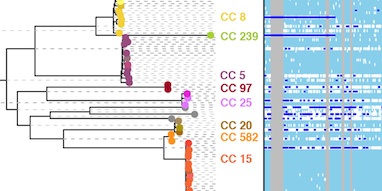
Correcting for recombination is important in a variety of settings. In transmission studies, recent transmission between patients can be detected by comparing the genomes of the infecting bacteria. As we show in the paper, ClonalFrameML improves detection of transmission events by accounting for the tendency of recombination to elevate the evolutionary distance between genomes. We also report the discovery of a remarkably large chromosomal replacement event spanning 310 kilobases that may have led to the evolution of the ST582 strain of Staphylococcus aureus, underlining the importance of recombination over short and long timescales.

ClonalFrameML is a much faster implementation of the popular ClonalFrame method by Xavier and Daniel Falush. It is based on the same underlying assumptions and the same explicit evolutionary model, so it provides interpretable estimates of rates of recombination, the length of DNA imported by recombination, and the relative impact of recombination versus mutation. However, it can now analyse thousands of whole bacterial genomes in a matter of hours, representing a substantial improvement over the earlier method.

Friday, 28 November 2014

New paper: bacterial phylogenetic inference is robust to recombination but demographic inference is not

Published this week in mBio, Jessica Hedge's new paper "Bacterial phylogenetic inference is robust to recombination but demographic inference is not" looks at a long-standing problem: why are phylogenetic trees so popular in bacterial genomics when everyone knows recombination (which is detectable in most species studied) leads to seriously misleading inference? A burst of research activity in the early 2000s showed that homologous recombination - which can result from various forms of horizontal gene transfer in bacteria - can distort phylogenetic trees and lead to false inference of positive selection and demographic growth in methods that rely on them.

In the intervening years there has been intense research in the field of population genetics into approaches that account for recombination, although the practically useful methods rely on approximations because of the inherent difficulties of learning about complex reticulated evolutionary networks that recombination generates. This has led many of my population genetics colleagues to regard - at least privately - the use of phylogenetic trees in recombining species as "bust", and the conclusions drawn from such studies as questionable. In this paper we show that this view is too simple.

FIG 1