Showing posts with label PLoS Genetics. Show all posts

Tuesday, 7 December 2021

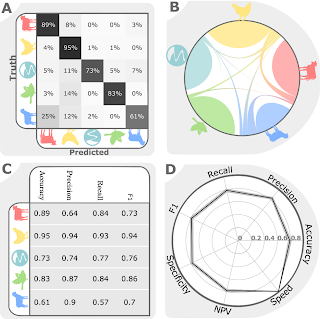
New paper: Machine learning to predict the source of campylobacteriosis using whole genome data

This study, published in October in PLOS Genetics, brings together machine learning, large bacterial isolate collections and whole genome sequencing to address the general problem of how to trace the source of human infections.

Specifically, we investigated campylobacteriosis, a common infection of animal origin causing ~1.5 million cases of gastroenteritis and 10,000 hospitalizations every year in the United States alone. We show that our combined machine learning/genomics analyses:

  • Improve the accuracy with which infections can be traced back to farm reservoirs.
  • Identify evolutionary shifts in bacterial affinity for livestock host species.
  • Detect changes in human infection capability within related strains.

These results will improve understanding not only of Campylobacter, but more generally as these technologies can readily be applied to other important bacterial pathogen species.
This paper builds on previous work published by the group, including our well cited Tracing the source of campylobacteriosis (Wilson et al 2008, PLOS Genetics 4:e1000203). The use of these methods for tracing infection has influenced public health policy and contributed to reducing disease burden.

This work demonstrates the potential for modern genomics and artificial intelligence approaches to address common and serious problems that affect our everyday lives. The awareness of the importance of infection to society has rarely been higher than in 2021, and while the current pandemic imposes an acute global problem, other infections continue to present long-term threats to health and productivity.

This work was led by Nicolas Arning, in collaboration with David Clifton and Sam Sheppard.

Monday, 17 August 2015

BASTA: Improved method for phylogeography

This week sees publication of our paper New Routes to Phylogeography: a Bayesian Structured Coalescent Approximation in PLoS Genetics.

Phylogeography is the recovery of migration history from genome sequences, and has exploded as a field in recent years. Over a thousand papers have used contemporary sequences and ancient DNA to reconstruct migratory trends, locate the origin of outbreaks and track the spread of infectious diseases. In many high profile examples phylogeography has informed our understanding of how major human pathogens spread.

In our new paper we solve a severe and apparently widely unappreciated problem: that the most popular approaches to phylogeography are heavily biased, extremely sensitive to sampling structure and substantially underestimate statistical uncertainty. The problems stem from the treatment of migration as equivalent to mutation (discrete trait analysis; DTA), and the assumption that sampling locations are phylogeographically informative.

To solve these problems we introduce and demonstrate a new method BASTA, implemented in the phylogenetic software package BEAST2, that employs a novel approximation to enable inference under the structured coalescent – the bottom-up population genetics model of migration. Previously, methods for exact inference under the structured coalescent have proven too slow for many practical purposes, hence the need for a fast and accurate approximation.

The biases we highlight with popular phylogeography methods are much more important than might appear from what is at one level a question of model choice. To underline this, we present an analysis of around 100 Ebola virus genome sequences to investigate the emergence of human outbreaks. Epidemiological studies have found that animals act as a reservoir, maintaining the virus between the sporadic human outbreaks that have unfolded over the past four decades, a scenario that our structured coalescent-based model correctly identifies.

Remarkably, DTA, the de facto standard method for phylogeography, wrongly concluded with high confidence that Ebola has been maintained since 1976 by undetected human-to-human transmission between outbreaks. Although such a conclusion would never be believed in the case of Ebola, it makes clear the potential for highly misleading inference about transmission that could, for much less well understood diseases, have serious implications for public health policy.

BASTA is the result of a lot of hard work by Nicola De Maio, who is a James Martin Fellow at the Oxford Martin School Institute for Emerging Infections, with help from Jessie Wu and Kathleen O'Reilly. You can read the paper here and download BASTA here.

Thursday, 16 August 2012

gammaMap available for download

The software gammaMap - which implements the analyses developed in Wilson, Hernandez, Andolfatto and Przeworski (2011) PLoS Genetics 7: e1002395 - is available for download. It is provided as part of a flexible program called GCAT (general computational analysis tool) which is designed to rapidly facilitate novel variations on the standard analyses. GCAT has its own google code page, http://code.google.com/p/gcat-project. GCAT resembles BEAST and BUGs in that a statistical model is specified (using XML) and parameters are then estimated using MCMC or maximum likelihood. Future extensions to GCAT are planned that implement new fast approximations to gammaMap and omegaMap, and parallel processing, allowing the analyses to be scaled more readily to whole genomes.

Friday, 2 December 2011

New method inferring natural selection published today

I am pleased to report that my new paper "A population genetics-phylogenetics approach to inferring natural selection" is published today in PLoS Genetics. This is the culmination of two years work at the University of Chicago with Molly Przeworski, plus a good deal of follow-up since I moved to Oxford. In the paper we introduce a new way of combining population genetics and phylogenetics models of natural selection, and a statistical method (gammaMap) for estimating parameters under the model. From a collection of sequences within one or more species - in the paper, we use 100 X-linked coding sequences that Peter Andolfatto produced in Drosophila melanogaster and D. simulans - the method allows you to estimate the distribution of fitness effects within each lineage, and localize the signal of selection using a Bayesian sliding window approach. Using Ryan Hernandez's simulator SFSCODE we tested the method for robustness to demographic change and linkage disequilbrium, and we investigated the effect that common assumptions concerning spatial variation in selection coefficients (sitewise, genewise and sliding window approaches) have on inference of selection. During the winter break I will work on compiling the program for different platforms and writing the documentation, with a view to releasing the software early in the New Year. Subscribe to this blog for updates or - if you are too impatient to wait - send me an email.