Showing posts with label Machine learning. Show all posts

Tuesday, 14 October 2025

New paper: Machine learning and statistical inference in microbial population genomics

We have published a new review article in Genome Biology contrasting machine learning and statistics in microbial genomics. This is joint work with Sam Sheppard, Nick Arning and David Eyre.

The availability of large genome datasets has changed the microbiology research landscape. Analyzing such data requires computationally demanding analyses, and new approaches have come from different data analysis philosophies. Machine learning and statistical inference have overlapping knowledge discovery aims and approaches.

In this review, we highlight how machine learning focuses on optimizing prediction, whereas statistical inference focuses on understanding the processes relating variables. We outline the different aims, assumptions, and resulting methodologies, with examples from microbial genomics. These approaches are essentially complementary, and we argue that exploiting both machine learning and statistics - selecting the right tool for the job - has the greatest potential for advancing pathogen research in the big data era.

Wednesday, 2 April 2025

Machine Learning versus Statistical Inference in Microbial Genomics

My talk given today at the 2025 Microbiology Society Conference in Liverpool:

Abstract

The advent of vast genomic datasets has transformed microbiology, presenting opportunities and challenges for data analysis. The distinct philosophies of machine learning (ML) and statistical inference gives them complementarity strengths and weaknesses in tackling big data problems in pathogen research. While statistical inference prioritizes understanding underlying relationships, ML focuses on optimizing predictive performance. In this talk I will contrast the approaches and offer a view on their relative utility for three problems: source attribution, bacterial genome-wide association studies, and predicting antimicrobial resistance phenotypes from whole genome sequences.

Tuesday, 7 December 2021

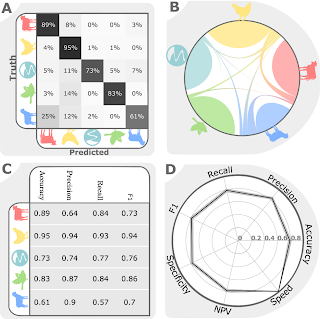
New paper: Machine learning to predict the source of campylobacteriosis using whole genome data

This study, published in October in PLOS Genetics, brings together machine learning, large bacterial isolate collections and whole genome sequencing to address the general problem of how to trace the source of human infections.

Specifically, we investigated campylobacteriosis, a common infection of animal origin causing ~1.5 million cases of gastroenteritis and 10,000 hospitalizations every year in the United States alone. We show that our combined machine learning/genomics analyses:

  • Improve the accuracy with which infections can be traced back to farm reservoirs.
  • Identify evolutionary shifts in bacterial affinity for livestock host species.
  • Detect changes in human infection capability within related strains.

These results will improve understanding not only of Campylobacter, but more generally as these technologies can readily be applied to other important bacterial pathogen species.

This paper builds on previous work published by the group, including our well cited Tracing the source of campylobacteriosis (Wilson et al 2008, PLOS Genetics 4:e1000203). The use of these methods for tracing infection has influenced public health policy and contributed to reducing disease burden.

This work demonstrates the potential for modern genomics and artificial intelligence approaches to address common and serious problems that affect our everyday lives. The awareness of the importance of infection to society has rarely been higher than in 2021, and while the current pandemic imposes an acute global problem, other infections continue to present long-term threats to health and productivity.

This work was led by Nicolas Arning, in collaboration with David Clifton and Sam Sheppard.

Friday, 21 August 2020

The group's research response to COVID-19

This is an update on the group's research response to the COVID-19 pandemic. As an infectious disease group we have been keen to contribute to the international research effort where we could be useful, while recognising the need to continue our research on other important infections where possible.

  • Bugbank. Thanks to a pre-existing collaboration between our group, Public Health England and UK Biobank, we were in a position to help rapidly facilitate COVID-19 research via SARS-CoV-2 PCR-based swab test results. Beginning mid-March, we worked to provide regular (usually weekly) updates of tests results, which were made available to all UK Biobank researchers beginning April 17th. This is one of several resources on COVID-19 linked to UK Biobank. Beginning in May we provided feeds to other cohorts: INTERVAL, COMPARE, Genes & Health and the NIHR BioResource. We provide updates on this work through the project website www.bugbank.uk. We have published a paper describing the dynamic data linkage in Microbial Genomics (press release). Key collaborators in this project are Jacob Armstrong (Big Data Institute) Naomi Allen (UK Biobank) and David Wyllie and Anne Marie O'Connell (Public Health England).


  • Epidemiological risk factors for COVID-19. Graduate student Nicolas Arning and I are developing an approach to quantify the effects of lifestyle and medical risk factors for COVID-19 in the UK Biobank that accounts for inherent uncertainty in which risk factors to consider. The new method employs the harmonic mean p-value, a model-averaging approach for big data that we published previously. We are in the process of evaluating the performance of the approach, comparing it to machine learning, and interpreting the results.

  • Antibody testing for the UK Government. Postdoc Justine Rudkin has been working in the lab with Derrick Crook, Sir John Bell and others to measure the efficacy of antibody tests for the UK Government. They have tested many hundreds of kits to establish the sensitivity and specificity of the tests to help evaluate the utility of a national testing programme. This work was crucial in demonstrating the limitations of early blood-spot based tests, and the credibility of subsequent generations of antibody tests. The work has been published in Wellcome Open Research.


Work on other infections that has continued during the lockdown. Postdoc Sarah Earle continues research into pathogen genetic risk factors for diseases including tuberculosis and meningococcal meningitis, while Steven Lin has continued to pursue work on hepatitis C virus genetics and epidemiology. Many of our close collaborators are infection doctors and they have of course been recalled to clinical duties. Laboratory work in the group has been severely disrupted, particularly several of Justine's Staphylococcus aureus projects. We are keen to pick up on those projects where we left off when the chance arrives.

Friday, 29 June 2018

PhD Studentship: Genomic prediction of antimicrobial resistance spread

This position is now closed
An opportunity has arisen for a D.Phil. (Ph.D.) place on the BBSRC-funded Oxford Interdisciplinary Bioscience Doctoral Training Partnership in the area of Artificial Intelligence, specifically Predicting the spread of antimicrobial resistance from genomics using machine learning.

If successful in a competitive application process, the candidate will join a cohort of students enrolled in the DTP’s one-year interdisciplinary training programme, before commencing the research project and joining my research group at the Big Data Institute.

This project addresses the BBSRC priority area “Combatting antimicrobial resistance” by using ML to predict the spread of antimicrobial resistance in human, animal and environmental bacteria exemplified by Escherichia coli. Understanding how quickly antimicrobial resistance (AMR) will spread helps plan effective prevention, improved biosecurity, and strategic investment into new measures. We will develop ML tools for large genomic datasets to predict the future spread of AMR in humans, animals and the environment. The project will create new methods based on award-winning probabilistic ML tools pioneered in my group (BASTA, SCOTTI) by training models using genomic and epidemiological data informative about past spread of AMR. We will apply the tools collaboratively to genomic studies of E. coli in Kenya, the UK and across Europe from humans, animals and the environment, Enterobacteriaceae in North-West England, and Campylobacter in Wales. Genomics has proven effective for asking “what went wrong” in the context of outbreak investigation and AMR spread; here we will address the greater challenge of repurposing such information using ML for forward prediction of future spread of AMR. Scrutiny will be intense because future predictions can and will be tested, raising the bar for the biological realism required while producing computationally efficient tools.

Attributes of suitable applicants: Understanding of genomics. Interest in infectious disease. Some numeracy, e.g. mathematics A-level, desirable. Experience of coding would help.

Funding notes: BBSRC eligibility criteria for studentship funding applies (https://www.ukri.org/files/legacy/news/training-grants-january-2018-pdf/). Successful students will receive a stipend of no less than the standard RCUK stipend rate, currently set at £14,777 per year.

How to apply: send me a CV and brief covering letter/email (no more than 1 page) explaining why you are interested and suitable by the Wednesday 11 July initial deadline. I will invite the best applicant/s to submit with me a formal application in time for the Friday 13 July second-stage deadline.